MenuClose
Sizing tool / ANSI-AGMA 6114-B15
Size a girth gear.
Enter mill geometry and drive power. The tool returns a face width, cross-checked three ways against published gear sets — and a Whitmore® open-gear lubricant recommendation from the same inputs.
01Mill configuration
Free text, for the report and CSV. The default reproduces the published worked example [9].
AGMA application factor. AG mills see the highest impact loading, ball mills the lowest.
Workbook basis only: dual pinion at 10 MW and above. Small mills size on load.
Reproduces this page's published figures. Critical speed uses the site convention nc = 76.6/√D (caveat 4, section 12). Benchmark face width by inverse-distance weighting of the published sets [8, 9]. Both bases give the same face width on the worked example, within rounding.
Advanced options & overrides
Blank uses the typical n = K/√D on the active basis.
Precedence: rpm override, then Cs override, then typical.
Per the published 20 MW gear design [8]: 21 teeth.
Drive output speed. Sets ratio and module on the workbook basis.
02Site, duty & lubrication inputs
These drive the lubricant selection in section 07. Temperature and application method are hard gates; the rest are weighted preferences.
Coldest expected at the spray unit and drum. Governs pumpability and grade — Envirolube service −8 °C; SKF pump minimum −5 °C Medium, +5 °C Heavy [E4] (pending datasheet checks).
Hottest expected. Pushes selection to heavier grades.
Yes relaxes the spray-pump minimum for the Heavy grades.
Damaged, pitted or scuffed teeth call for the surface-repair product — see the cautions in section 07.
Bath / immersion excludes greases and favours filterable fluids with no solids.
Wet duty favours the tenacious wash-off-resistant film.
Crews monitor tooth contact in service through a clear film.
Favours the product whose used-lubricant TCLP result is datasheet-verified.
Matched against the datasheet-verified approvals in section 07. Other: confirm with CMD.
03Gear sizing result
Recommended girth gear face width
1,040mm
Module m = 38.0 mm · 286 / 21 teeth · pinion 136 rpm
Est. SF 2.71 ≥ 1.75 target
- Girth gear face width F
- 1,040 mm
- Pinion face width
- 1,040 mm
- Girth / pinion teeth
- 286 / 21
- Gear ratio
- 13.6:1
- Pinion speed
- 136 rpm
- Operating load intensity Wt/F
- 1,034 N/mm
- Design load intensity (Ka=1.30)
- 1,344 N/mm
- Benchmark-interpolated face width
- 1,034 mm
- Load-based minimum face width
- 671 mm
- Published dual-pinion band [8, 9]
- 1,016–1,080 mm
- Recommended Whitmore product
- Envirolube XE Extreme · Heavy (4,000 cSt)
- Indicative consumption (recommended product)
- enter the site rate — section 08
Recommendation
For a 34.0 ft sag mill (L/D = 0.59) at 12.7 MW with dual pinion, a girth gear face width of 1,040 mm is recommended (pinion ≈ 1,040 mm). Mill speed 10.01 rpm (42% of critical) gives pitch-line velocity 5.70 m/s. At 12.7–20 MW dual-pinion class, published plants cluster at 1,016–1,080 mm face width [8, 9]. Estimated durability factor 2.71 meets the target AGMA minimum for preliminary screening.
04Method, step by step
- 01Mill speed from typical n = K/√D with L/D adjustment, K = 32.3: n = 10.01 rpm (42.0% of critical; nc = 76.6/√D = 23.80 rpm).
- 02Pitch diameter dp = 1.05 × 10.36 = 10.88 m.
- 03Pitch-line velocity v = π·dp·n/60 = 5.70 m/s (AGMA limit 10.16 m/s).
- 04Power per pinion = 12.7 MW / 2 × η = 6,128 kW.
- 05Tangential load Wt = P/v = 1,075 kN; design load Wt×Ka = 1,398 kN.
- 06Benchmark face width (interpolated from [8, 9]): F_bench = 1,034 mm.
- 07Load-based face width for SF ≥ 1.75: F_load = Wt×Ka / (LI_ref×SF_ref/SF_target) = 671 mm.
- 08Recommended girth gear face width F = max(F_load, F_bench), rounded up to 10 mm and capped at 1,800 mm → 1,040 mm (pinion ≈ 1,040 mm).
- 09Module and teeth: m = 38.0 mm, z_girth/z_pinion = 286/21, ratio 13.6:1.
- 10Durability screening: LI = 1,344 N/mm → estimated SF = 2.71 (reference SF 2.75 at 1,325 N/mm [8]).
- 11AGMA 6114-B15 screening: PASS.
- 12Duty class for lubricant grade: Heavy (6.1 MW per mesh, v = 5.7 m/s, SAG mill).
- 13Lubricant gates: site ambient 5 to 40 °C, automatic spray system, heating No — temperature and application feasibility per product.
- 14Weighted preference (condition · application · environment · transparency · TCLP · OEM approval) — Envirolube XE Extreme — Heavy (4,000 cSt); alternative Decathlon Gold — Heavy (5,202 cSt).
| Parameter | Value | Unit |
|---|---|---|
| Mill type | SAG mill | — |
| Aspect ratio L/D | 0.59 | typical |
| Duty / shock factor Ka | 1.30 | typical for type |
| Critical speed nc = 76.6/√D (site convention) | 23.80 | rpm |
| Fraction of critical Cs | 42.0 | % |
| Mill speed n | 10.01 | rpm |
| Girth pitch diameter dp | 10.88 | m |
| Pitch-line velocity v | 5.70 | m/s |
| Pinion arrangement | Dual pinion (2×) | — |
| Power per pinion mesh | 6,128 | kW |
| Operating tangential load Wt | 1,075 | kN |
| Design load Wt × Ka | 1,398 | kN |
| Girth gear torque T | 5,848 | kNm |
The report and CSV carry your current live values. Nothing you type here leaves the browser.
05Drive topology and AGMA checks
Drive topology
Dual-pinion ring gear
12.7 MW total · 17,031 HP
Face width class
Large
Published 12.7–20 MW dual-pinion: 1,016–1,080 mm [8, 9]
Pinion power / mesh
6.1 MW
Limit ~10 MW per pinion [1, 12]
| Check | Criterion | This case | Status |
|---|---|---|---|
| Pitch-line velocity | ≤ 10.16 m/s (AGMA 6114 [16]) | 5.70 m/s | Pass |
| Module m | 8 – 50 mm [16] | 38.0 mm | Pass |
| Face width — upper manufacturing limit [8] | ≤ 1,800 mm (required width before cap) | 1,040 mm | Pass |
| Face width — conservative reference limit [live ref 9] | ≤ 1,250 mm typical | 1,040 mm | Pass |
| Published plant band [8, 9] | 1,016–1,080 mm | 1,040 mm | Pass |
| Power per pinion | < 10 MW [1, 12] | 6.1 MW | Pass |
| Est. durability SF | ≥ 1.75 (ref. [8]) | 2.71 | Pass |
| Geared power envelope | ≤ ~18 MW [1, 3] | 12.7 MW | Pass |
PASSFail = outside an AGMA / manufacturing limit or below target SF. Check = outside typical or published practice; review before proceeding.
06Benchmark comparison
Published gear sets [8, 9] with stated geometry. Your design point is overlaid.
| Reference | Type | D (m) | L/D | Power (MW) | Pinions | Face width (mm) | Module (mm) | n (rpm) | v (m/s) | P/mesh (kW) | Wt (kN) | LI oper. (N/mm) | LI design (N/mm) |
|---|---|---|---|---|---|---|---|---|---|---|---|---|---|
| 12.2 m SAG [8] | SAG mill | 12.20 | 0.55 | 20.0 | 2 | 1,070 | 42 | 9.24 | 6.20 | 9,650 | 1,557 | 1,455 | 1,892 |
| 8.5 m ball [8] | Ball mill | 8.50 | 1.60 | 20.0 | 2 | 1,070 | 42 | 11.09 | 5.18 | 9,650 | 1,862 | 1,740 | 2,175 |
| 10.36 m SAG [9] | SAG mill | 10.36 | 0.59 | 12.7 | 2 | 1,016 | — | 10.08 | 5.74 | 6,128 | 1,067 | 1,050 | 1,365 |
| 7.32 m ball [9] | Ball mill | 7.32 | 1.65 | 12.7 | 2 | 1,050 | — | 11.89 | 4.78 | 6,128 | 1,281 | 1,220 | 1,526 |
| 5.0 m cement ball [4] | Ball mill | 5.00 | 2.20 | 6.7 | 1 | — | — | 14.00 | 3.85 | 6,466 | 1,680 | — | — |
| Your design | SAG mill | 10.36 | 0.59 | 12.7 | 2 | 1,040 | 38.0 | 10.01 | 5.70 | 6,128 | 1,075 | 1,034 | 1,344 |
Interpolation basis: transmitted torque governs face width more than mill diameter [8, 9]; no single published F = f(D) exists. The 5.0 m cement ball set [4] states no face width, so it is listed but excluded from the weighting.
07Whitmore lubricant recommendation
From the same inputs. The gates, weights and scores are shown in full below.
Recommended
Envirolube XE Extreme
Non-asphaltic high-viscosity fluid · Most recommended · non-asphaltic
Heavy (4,000 cSt)recommended grade
- Viscosity @ 40 °C
- Medium · 1,080 cSt / Heavy · 4,000 cSt
- Service temperature
- −8 °C to 111 °C
- 4-ball weld · FZG
- 800 kg · FZG A/2.76/50 · 0.067 mg/kWh (Heavy)
- OEM approvals · specs
- On approval list: Metso Minerals (Heavy) · Foster Wheeler (Heavy). Qualified, Metso Table 2: Metso:Outotec (Heavy). Meets specification: Metso Minerals (Medium · Heavy) · Falk (Medium · Heavy) · FLSmidth (Medium · Heavy, intermittent spray systems).
Alternative
Decathlon Gold
Heavy (5,202 cSt)
Second-highest score under the current gates and preferences.
Lubrication duty class (film demand, from sizing)
Heavy
Assumption for grade selection only, not the AGMA Ka. Heavy at ≥ 5 MW per mesh, at v ≤ 4.5 m/s, or for AG mills; Moderate at ≥ 2.5 MW per mesh; otherwise Light. This case: 6.1 MW per mesh at 5.70 m/s, SAG mill.
Why this product
Selected on: transparent film for in-service inspection; datasheet-verified TCLP-safe waste; the preferred non-asphaltic fluid — lowest FZG specific mass loss of the compared products (section 10) [E1, E3]. Service range covers 5 to 40 °C ambient. Heavy duty at 5.7 m/s.
Cautions
Trace-heat the drum and lines below the SKF pump minimum (−5 °C Medium, +5 °C Heavy) [E4] — pending datasheet checks. Non-asphaltic: no hardening in the tooth root, and the film runs clear. Viscosity rises sharply on application as sacrificial diluent evaporates. Metso:Outotec doc 3-21-003 Table 2 qualifies XE Extreme in the Heavy grade [E2]. Confirm against the current Whitmore TDS at quote — seventeen of the twenty-four tracked records are datasheet-verified; the rest stay pending (section 09). OEM approval status changes and should be reconfirmed at specification time.
| Product | Base | Temp. gate | App. gate | Condition | Application | Environment | Transparency | TCLP | OEM | Total | Rank | Grade for this case |
|---|---|---|---|---|---|---|---|---|---|---|---|---|
| Envirolube XE Extreme | 30 | 1 | 1 | 0 | 0 | 0 | 20 | 20 | 0 | 70.05 | 1 | Heavy (4,000 cSt) |
| Decathlon Gold | 20 | 1 | 1 | 0 | 0 | 0 | 20 | 0 | 0 | 40.04 | 2 | Heavy (5,202 cSt) |
| GearMate 1000 ICT | 15 | 1 | 1 | 0 | 0 | 0 | 0 | 20 | 0 | 35.03 | 3 | Super Heavy 0-1 |
| SurStik 800 | 15 | 1 | 1 | 0 | 0 | 0 | 0 | 0 | 0 | 15.02 | 4 | Heavy 0 (4,380 cSt) |
| BMG-6000 | 5 | 1 | 1 | 0 | 0 | 0 | 0 | 0 | 0 | 5.01 | 5 | Single grade — high-viscosity (per PDS) |
Temperature and application feasibility are hard gates (1 = feasible, 0 = excluded). Weights: surface repair 100 · bath, filterable fluid 50 · bath, other fluid 15 · manual or drip, tacky grease 5 · wash-off, tenacious film 30 · wash-off, non-emulsifying grease 10 · transparent film 20 · TCLP-safe 20 · OEM approval match 25. A small tie-break favours the earlier row. Held = the preference would apply, but its backing record is pending datasheet verification — sections 09 and 14 carry the records.
| Product | Type | Grades · viscosity @ 40 °C | 4-ball weld | FZG | Service temp. | Spray | Bath | Transparent | TCLP | OEM approvals |
|---|---|---|---|---|---|---|---|---|---|---|
| Envirolube XE Extreme | Non-asphaltic high-viscosity fluid | Medium · 1,080 cSt / Heavy · 4,000 cSt | 800 kg | A/2.76/50 · 0.067 mg/kWh (Heavy) | −8 °C to 111 °C | Yes | Yes | Yes | Yes | On approval list: Metso Minerals (Heavy) · Foster Wheeler (Heavy). Qualified, Metso Table 2: Metso:Outotec (Heavy). Meets specification: Metso Minerals (Medium · Heavy) · Falk (Medium · Heavy) · FLSmidth (Medium · Heavy, intermittent spray systems). |
| Decathlon Gold | Synthetic open-gear lubricant | Gold ISO 3200 · 3,260 cSt / Heavy · 5,202 cSt / Super Heavy · 15,500 cSt | 620 kg (>800 kg Super Heavy) | n/s | down to −7 °C · no upper bound stated | Yes | Yes | Yes | n/s | On approval list: Metso Minerals (Heavy). Qualified, Metso Table 2: Metso:Outotec (Heavy). |
| GearMate 1000 ICT | Lithium open-gear grease, five grades | Arctic 000 · 1,900 cSt / All-Season 00 · 1,900 cSt / Light 0-00 · 1,900 cSt / Heavy 0 · 4,123 cSt / Super Heavy 0-1 · 6,500 cSt | 800 kg (all grades) | n/s | down to −40 °C · no upper bound stated | Yes | No | No | Yes | Approved by email: Outotec. Meets specification: Caterpillar SD 4713 (Super Heavy, shovel hoist drum gears). Approved (PDS): PRASA (Heavy). |
| SurStik 800 | Aluminium-complex open-gear grease | Arctic (Thick Fluid) · 1,520 cSt / Medium 000 · 2,620 cSt / Heavy 0 · 4,380 cSt | 800 kg (all grades) | n/s | −43 °C to 121 °C | Yes | No | No | n/s | On approval list: Bucyrus SD 4713 (Arctic · Medium · Heavy) · Bucyrus blast-hole drill OGL. Approved by email: Outotec. Meets specification: P&H #520 · P&H Spec 464. Meets specification or approved (PDS): Komatsu · IHI (Japan) · PRASA (South Africa). |
| BMG-6000 | Synthetic open-gear grease (surface repair) | Single grade · High viscosity (per PDS) | n/s | n/s | down to −4 °C · no upper bound stated | Yes | No | No | n/s | — |
'n/s' = not stated in the document set. MillGuard (high-viscosity petroleum-resin fluid) and Surtac 2000 are also in the open-gear line — TDS on request; information only, not scored.
Figures are from the Whitmore document set of 2 June 2026, pending datasheet checks. Confirm against current Whitmore TDS at quote.
- Case OEM match
- No OEM approval requirement set.
- Recommended initial spray-cycle interval
- 5–15 min — Envirolube XE Extreme is a fluid. Reference bands and the application-rate basis: section 10 [E2, E8].
Request a quote
Send mill size, gear condition and current product. A worked cost-per-hour comparison comes back.
08Consumption, energy & cost in use
Asphaltic reference against the recommended Whitmore product. Cost rows stay blank until you enter the rates and prices. The decision metric is cost per operating hour, not price per kilogram. A premium non-asphaltic can cost several times an asphaltic per kilogram and still be cheaper in service. Consumption falls to a fifth or a tenth in the documented field cases [E1].
≈ 91% availability at the default.
Take the rate from your spray-system settings and site consumption records. The paper's consumption evidence (section 10) shows what the change typically does.
Your site's current delivered price per kilogram.
CMD quoted price per kilogram for the recommended product and grade.
Default 0.50 × (about half the asphaltic rate). The published field record is stronger — 70–90% lower across the paper's cases: a 2015 South African gold-mine trial (≈70%, 0.30 ×), a platinum operation (90%, 0.10 ×) [E7], a US cement producer (90%) and a US power plant (≈40%) [E1]. The table below carries the 70% and 90% cases beside your setting.
| Parameter | Asphaltic reference | Recommended product | Unit |
|---|---|---|---|
| Consumption | enter site rate | enter site rate | kg/h |
| Consumption | enter site rate | enter site rate | kg/day |
| Consumption | enter site rate | enter site rate | t/yr |
| Lubricant cost | enter prices | enter prices | A$/yr |
| Cost per operating hour | — | — | A$/h |
| Lubricant-only saving (asphaltic − recommended) | — | enter prices | A$/yr |
| Documented field case — 70% less consumed (0.30 ×) [E1] | enter site rate | enter site rate | t/yr |
| Documented field case — 90% less consumed (0.10 ×) [E1] | enter site rate | enter site rate | t/yr |
| Saving at the documented 70–90% band [E1] | — | enter prices | A$/yr |
Energy saving — specific grinding energy
The paper's headline effect. The 2015 South African gold-mine trial was independently assessed at −4.03% specific grinding energy [E5]. CMD reproduced it three ways from raw SCADA: −3.92% aggregate, −5.2% by daily means (p = 0.024), −4.4% by ANCOVA [E1]. Field references place the effect in a 3–16% band [E1].
Your site's price. The paper's worked Australian-mill model sits behind the gated download.
Average draw as a fraction of installed power.
Best-verified single figure ≈ 4%. Field band 3–16% [E1].
Energy saving value
enter electricity price
A$/yr at the current setting
| Parameter | Value | Unit | Basis |
|---|---|---|---|
| Average mill draw | 12,700 | kW | Installed 12.7 MW × load factor 1.00 |
| Annual energy at the mill | 101,600,000 | kWh/yr | 12,700 kW × 8,000 h/yr |
| Annual electricity cost | enter electricity price | A$/yr | At your entered A$/kWh |
| Energy saved at 4.0% | 4,064,000 | kWh/yr | Specific-energy reduction applied to mill draw |
| Energy saving value at 4.0% | enter electricity price | A$/yr | Best-verified ≈ 4% [E1]; the paper's worked A$ model is in the gated download. |
| Documented field band 3–16% [E1] | enter electricity price | A$/yr | The platinum operation ≈12% [E7] · two ball mills at one operation −9.4% and −16.7% · monitored mills −3% and −9% · the 2015 trial −3.9% to −5.2% [E1] |
| Lubricant-only saving (from the table above) | enter prices | A$/yr | Purchase cost only, at your consumption setting |
| Combined energy + lubricant benefit | enter prices | A$/yr | Before wear, downtime, hazardous-waste and incentive credits [E1] |
The energy figures above are an indicative valuation, not a site measurement. A single before-and-after switch confounds the lubricant with ore, moisture and ageing drift. Before any fleet-wide commitment, run a randomised ON/OFF (switchback) trial: 12 paired periods at SCADA logging resolution, roughly three to four months [E1, E8]. Lubricant consumption is the fast confirmatory endpoint; mill specific energy is the primary one. The 2015 reanalysis measured the noise term directly (σd = 0.73 kWh/t at SCADA resolution), so the trial length is calculated rather than guessed [E1].
09Disclaimer & terms of use
This tool provides a preliminary screening estimate only — not a substitute for a certified AGMA 6114-B15 pitting and bending calculation with project-specific materials (e.g. 310–325 BHN girth, 57 HRC pinion per [8]), alignment, and lubrication data. Face-width benchmarks are interpolated from published dual-pinion plants at 1,016–1,080 mm [8, 9]. Do not apply operating-plant load intensity to design loads (Wt × Ka) when scaling face width — that mix overstates width beyond practical manufacturing limits. © CMD Consulting Pty Ltd.
Lubricant figures are from the Whitmore document set of 2 June 2026. Seventeen of the twenty-four tracked records are verified against current Whitmore datasheets; the rest stay pending. Confirm against the current Whitmore TDS at quote. Grade rules and intermediate low-temperature limits are assumptions between the stated end-points.
10Technical evidence — energy, wear & OEM requirements
Sourced from the published conference paper [E1]. Evidence is labelled by tier: independently reanalysed, independently published, third-party reported, and vendor reported. Only the 2015 South African gold-mine energy result has been reanalysed from raw data.
Download the conference paper (PDF)
DANIEL, M.J., DANIEL, K. and DAVIES, L. (2026). Technical conference paper, 12 pp. CMD Consulting Pty Ltd, Brisbane, and Whitmore Manufacturing LLC, Rockwall, Texas. Name, company and email first.
Laboratory wear — FZG, ISO 14635-3 (setting A/2.8/50)
| FZG test | Product #1 | Product #2 | Product #3 | Envirolube XE Extreme Heavy |
|---|---|---|---|---|
| Load stages passed | >12 | >12 | >12 | >12 |
| Mass loss after 12 stages (mg) | 32 | 51 | 21 | 9.2 |
| Specific mass loss @ Stage 12 (mg/kWh) | 0.1715 | 0.1800 | 0.1390 | 0.067 |
| Mass loss after 30 h @ Stage 10 (mg) | 41 | 22 | 78 | 20 |
The comparison products stay anonymised by number, as the paper publishes them. Envirolube XE Extreme Heavy passed the full >12 load stages, then an extended 30-hour test with the original crosshatch machining pattern still clearly visible. Third-party testing reported a 66% reduction in friction and wear overall [E1, E3].
Field and laboratory evidence
| Case / source | Change made | Reported result | Evidence tier |
|---|---|---|---|
| 2015 South African gold-mine trial — CMD reanalysis of raw SCADA [E1, E5] | Envirolube XE Extreme on the open gear; Decathlon Extreme 220 in the reducer | Specific grinding energy −3.92% aggregate; −5.2% by daily means (one-sided p = 0.024); −4.4% by power-at-constant-feed ANCOVA (t = 11.5, p < 10⁻²⁸). Open-gear consumption 4.7 → 1.4 kg/day (≈70%). | Independently reanalysed |
| Independent assessment of the same trial [E5] | As above | Specific grinding energy 20.85 → 20.01 kWh/t (−4.03%); ≈70% lower open-gear consumption. | Independent |
| Platinum operation — signed reference letter, 10 Jun 2014 [E7] | Girth-gear open-gear lubricant conversion on a large mill | Mill motor 5.6–5.4 MW → 5.0–4.8 MW (≈400–600 kW, ≈12%); consumption 800 → 80 kg/month (90%); reduced pinion ΔT; improved vibration. | Third-party reported |
| Published OGL field trial — two ball mills [E1] | Incumbent OGL → unique performance-polymer synthetic OGL | Energy −9.4% (mill 09) and −16.7% (mill 10); lower operating temperature; relube interval extended 20 → 25 min. | Vendor reported |
| Third-party M&V summary, South Africa [E1] | Energy-reducing gear lubricants on conveyor and mill gearboxes | Conveyor gearbox −4%; mills −3% and −9%; temperature drops of 10–15 °C. | Third-party reported |
| Power plant, Indiana — manufacturer field record [E1] | Switched to Envirolube XE Extreme on a large ball-mill / pulveriser open gear | ≈40% reduction in open-gear lubricant consumption. | Vendor reported |
| US cement producer — kiln and ball mills [E1] | Competitor asphaltic → non-asphaltic synthetic; spray system retained | Consumption 30 → 3 barrels/year (90%); spray volume safely cut to ≈1/10; gear noise and tooth temperature dropped markedly; +33% gear life reported. | Vendor reported |
| Major cement plant — non-asphaltic OGL [E1] | Old asphalt compound → non-asphaltic, solvent-free OGL | Open-gear life +33%; lubricant usage −80%+; nozzle clogging eliminated; gear build-up and abrasive wear stopped. | Independently published |
| Ore-processing plant — specialty OGL field test (STLE/TLT, Dec 2022) [E7] | Asphaltic → specialty OGL on a pinion | Pinion temperature reduced ≈30 °C; pitch-line micropitting addressed. The site held power constant and raised output, taking the gain as throughput. | Independently published |
| Laboratory — FZG, ISO 14635-3 A/2.8/50 [E1, E3] | Envirolube XE Extreme Heavy against three comparison products | Specific mass loss 0.067 mg/kWh against 0.139–0.180; a third-party-reported 66% reduction in friction and wear; crosshatch machining pattern still visible after an extended 30-hour run. | Third-party tested |
Read together, the mill energy effect clusters in a ≈3–16% band with the best-verified single number at ≈4%. The larger and more certain effect everywhere is the 70–90% reduction in lubricant consumption, measured directly and not confounded by ore or throughput. General lubrication literature documents a 5–15% power reduction from lubricant and reliability upgrades; this mill-specific evidence sits at the conservative end of that band, and is measured rather than asserted [E1, E7].
OEM minimum requirements — cited record [E2]
The OEM's open-gear guideline sets the bar a mill lubricant must clear before it is considered, and asks for proof in similar service. Viscosity is graded to the working environment temperature, not the mill temperature — which is why this tool takes site ambient minimum and maximum rather than gear temperature.
| Property (test) | Requirement | Note |
|---|---|---|
| Base oil / product viscosity (ASTM D445) | ≈ 4,140 cSt @ 40 °C (cold, −10 to +5 °C) up to 8,170 cSt @ 40 °C (>40 °C ambient); ≥ 430–860 cSt @ 100 °C | Graded to the working environment temperature, not the mill temperature |
| FZG scuffing (DIN 51354) | ≥ 12 load stages | Scuff resistance |
| Four-ball weld load (ASTM D2596) | 250 kg | Extreme pressure capacity |
| Four-ball load wear index | 45 | Load carrying |
| Four-ball wear scar | 0.75 mm | Antiwear |
| Timken OK load (ASTM D2782) | 50 lb | Film strength under load |
| Rust & oxidation inhibitors; antiscuff additives; solid lubricants (grease) | Required | System, not a single property |
Qualified products list — Table 2 of the same document [E2]
The Whitmore entries are Envirolube® XE (Medium, Heavy), Envirolube® XE Extreme (Heavy) and Decathlon® Gold (Heavy); Envirolube® and Envirolube® Extreme appear as discontinued. Note 3 records that the XE family is formulated with a very high viscosity synthetic polymer rather than a true oil, so the Table 1 viscosity minima are read as indicative for that family. GearMate® 1000 ICT, SurStik® 800 and BMG-6000 are not listed for horizontal grinding mills. Inclusion is a qualification against the minima and service history, not an exclusive endorsement, and the guideline asks that the issuer's engineering group be consulted for a specific project.
Legacy asphaltic against the modern non-asphaltic approach
| Attribute | Type I — asphaltic / solvent cutback (legacy) | Type II — non-asphaltic HV fluid / advanced OGL |
|---|---|---|
| Film / EP | Timken OK load ≈ 20–25 lb; relies on a viscous film | Timken ≈ 70 lb; four-ball weld > 800 kgf; chemical and physical EP |
| Spent product | Hardens; builds up in tooth roots; picks up dirt | Does not harden; easy clean-down; smooths (planishes) flanks in service |
| Consumption | High; short spray intervals as solvent slows | Low; falls to one fifth to one tenth in service |
| HSE | Solvent / VOC and disposal issues; heavy metals in older grades | TCLP compliant; free of bitumen and heavy metals; sprays well in automatic systems |
The move from Type I to Type II is the change every field case above has in common [E1, E2].
Delivery — the lubricant is only as good as its application
The OEM guideline specifies intermittent spray onto the loaded flanks as they come out of mesh above the pinion, giving nearly one full revolution for any diluent to evaporate before the contact zone. Quantity is set at 1.5 × the AGMA 6014-B15 Table D.3 rate [E2, E8]. Manual application on a large girth gear is slow, inconsistent and exposes people to a rotating gear, so automatic intermittent spray (Lincoln, SKF, Graco or Farval) is standard [E1, E2].
- Asphaltic (legacy reference)
- 15–20 min
- Oil / non-asphaltic fluid
- 5–15 min
- Grease
- 2–5 min
Initial spray-cycle interval reference bands by lubricant class [E1, E2]. The case-specific line renders in section 07.
The enclosed reducing gearbox
The mill drive train has two lubricated elements, and this tool sizes only the open gear. The enclosed reducer is the second single point of failure: a ≈1,000 rpm motor drives down to a ≈150–200 rpm pinion, which meshes with the girth gear turning the shell at roughly 9–15 rpm — an overall reduction of the order of 65–70:1 [E1].
- Recommended reducer oil
- Decathlon Extreme 220
- Contamination control
- Air Sentry® / Guardian desiccant breather
- Specification route
- AGMA 9005
The gear oil applied alongside the open-gear change in the 2015 South African gold-mine trial [E1]. TDS on request. The breather keeps moisture and dust out — a reliability ancillary that protects the gears but does not lubricate them. Enclosed gear oils are selected against the gearbox OEM's AGMA 9005 requirements. No separate OEM qualification letter for this oil is held in the CMD project record — confirm with the reducer OEM. Monitor wear-metal generation rate (Fe, Cu, PQ index) with oil temperature, FTIR oxidation and water; temperature, power draw and oxidation carry the statistical weight.
How the savings arise — physical mechanisms
- 01Higher film strength and EP capacity. Moving from a ≈20–25 lb Timken asphaltic to a ≈70 lb non-asphaltic with four-ball weld > 800 kgf keeps mating flanks separated under shock and slow-speed boundary contact, cutting the metal-to-metal friction that both wears teeth and wastes drive power [E1].
- 02Direct friction reduction. Third-party testing measured a 66% reduction in friction and wear against the comparison. Lower friction in the mesh is, directly, lower parasitic power draw at constant ore load [E1, E3].
- 03Flank smoothing in service (planishing). The additive package deforms surface asperities with minimal wear, flattening the tooth surface instead of abrasively removing metal. A smoother flank raises the specific film thickness and lowers friction — and removes the need for a separate abrasive run-in compound on new or re-toothed gears [E1, E6].
- 04Stable, non-hardening film. Spent product does not harden or build up in the tooth roots, so the film stays uniform between spray cycles. Asphaltics can starve the contact if solvent has not evaporated, or build up and misdistribute load [E1].
- 05Lower operating temperature. Reduced friction shows up as lower pinion and flank temperature — field cases report 10–30 °C reductions — which slows oxidation and extends gear and oil life [E1].
- 06Dramatically lower consumption. A tenacious non-asphaltic film that resists water wash-off and does not need frequent replacement cuts application rate by 70–90% in the field cases: the fastest and most certain saving, and the one that offsets the unit-price premium [E1].
Not monetised in section 08: the third-party-measured 66% reduction in friction and wear (FZG, ISO 14635-3), 10–30 °C lower operating temperature (≈30 °C pinion reduction in the STLE/TLT 2022 field test), +33% open-gear life reported at two cement plants, in-service flank smoothing that can replace an abrasive run-in step, no tooth-root clean-down, and a TCLP-safe waste stream. Reduced downtime and hazardous-waste disposal are additional credits that are harder to isolate [E1, E7].
Evidence quality — stated plainly
Only the 2015 South African gold-mine energy result has been independently reanalysed from raw data. The platinum, trial, cement-plant and power-plant results are vendor- or third-party reported under differing conditions, and are directional rather than guaranteed. The consistent direction and magnitude across independent sources is the strength; the absence of controlled replication at most sites is the limitation. A single before-and-after cannot separate the lubricant from ore, moisture and ageing drift — the switchback design in section 08 is the mitigation, and should precede any fleet-wide commercial decision [E1].
11Basis of girth gear design
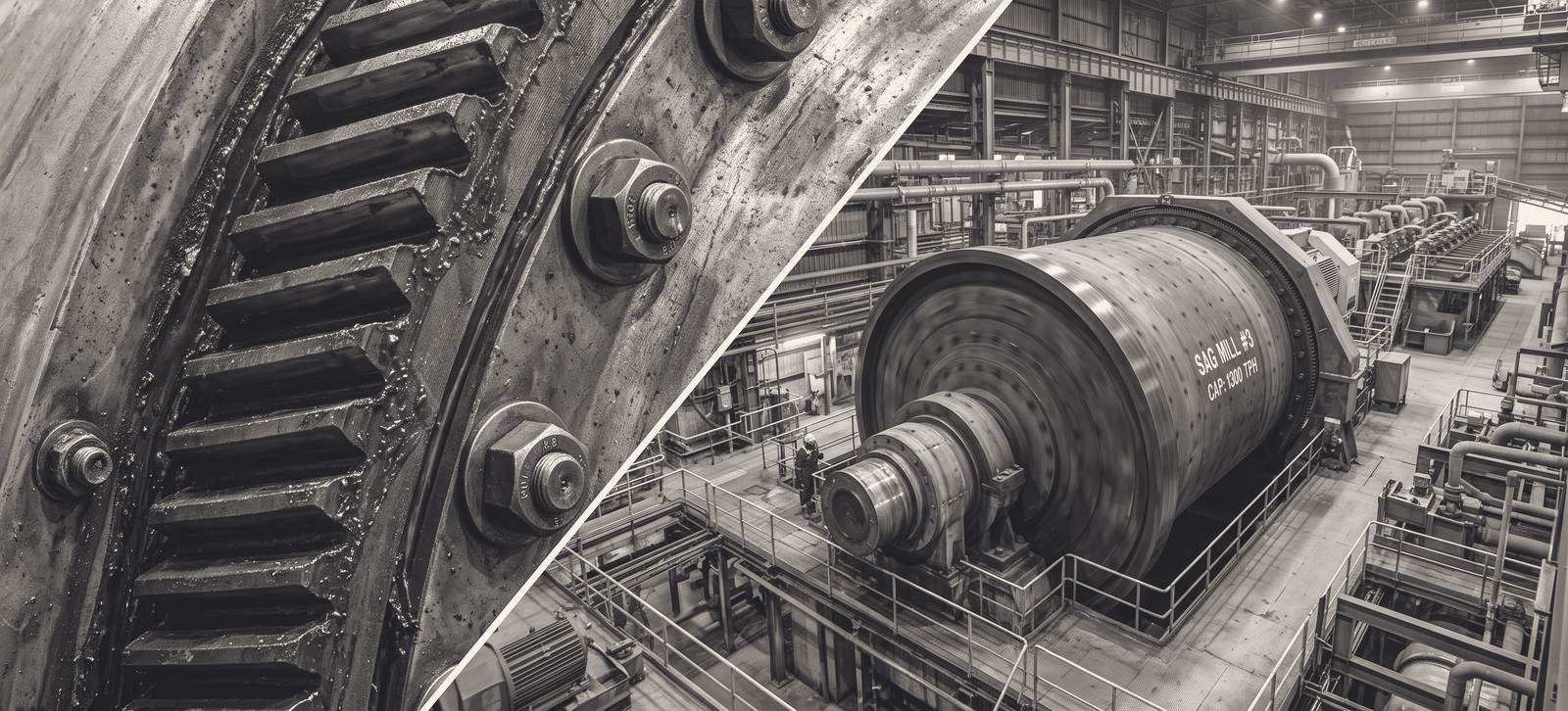
Girth gear and pinion sizing for tumbling mills is driven primarily by transmitted torque at the pitch circle — motor power divided by pitch-line velocity — rather than by mill diameter alone. Published dual-pinion installations at 12.7 and 20 MW cluster at face widths of 1,016–1,080 mm despite mill inside diameters from 7.3 to 12.2 m [8, 9]. No single published formula F = f(D) exists. Selection should follow AGMA rating practice using connected motor power, mill speed, module, duty factor, and material data [16].
Load path and AGMA 6114 basis
ANSI/AGMA 6114-B15 [16] rates cylindrical shell- and trunnion-supported equipment (grinding mills, kilns) on connected motor nameplate power including service factor. Tangential load on the girth gear pitch circle is:
Design load = Wt × Ka
Load intensity = Wt / F (N/mm)
Pitch-line velocity is v = π · dp · n / 60, with girth pitch diameter typically ≈ 1.05 × shell ID. Limits include v ≤ 10.16 m/s and module 8–50 mm [16]. The published 20 MW gear design [8] uses a 25° pressure angle, 7.5° helix and 21 pinion teeth. It reports AGMA durability factors of 1.81–3.20 on 20 MW class gears.
Drive topology and aspect ratio
Industry boundaries from the literature review [1, 3]: single-pinion ring gear to ~9 MW total; dual pinion to ~18 MW; above that, gearless drives dominate. Mill speed is correlated empirically as n ≈ K / √D (K ≈ 32.3 for SAG and ball, 33.5 for AG), with a small reduction for long mills (high L/D). Aspect ratio affects filling and impact loading: AG mills use higher duty factors (Ka ≈ 1.35) than ball mills (Ka ≈ 1.25).
Face-width selection in this calculator
Recommended face width is the greater of two figures. (a) A load-based width for the target durability factor, scaled from the published pinion benchmark [8] (SF ≈ 2.75 at 1,325 N/mm). (b) Benchmark interpolation from the published gear sets [8, 9] at similar power and diameter. Results are rounded to 10 mm and capped at the upper manufacturing limit of 1,800 mm [8]. Published tooth widths at large low-speed dual-pinion plants have reached ~1.4 m [9]. A conservative reference limit of 1,250 mm is published as a practical maximum [live ref 9].
Reference constants & typical values
| Constant | Value | Unit |
|---|---|---|
| Critical speed constant — CMD workbook (nc = const/√D, D in m) | 42.3 | rpm·m^0.5 |
| Critical speed constant — site engine (as published; see caveat 4) | 76.6 | rpm·m^0.5 |
| Reference load intensity LI_ref (pinion benchmark) [8] | 1,325 | N/mm |
| Reference AGMA durability factor SF_ref [8] | 2.75 | — |
| Face width — upper manufacturing limit [8] | 1,800 | mm |
| Face width — conservative reference limit [live ref 9] | 1,250 | mm |
| Pitch-line velocity limit [16] | 10.16 | m/s |
| Module range [16] | 8 – 50 | mm |
| Power per pinion mesh — practical limit [12], cited in [3] | 10 | MW |
| Single-pinion ring-gear envelope (total power) [1, 3] | 9 | MW |
| Dual-pinion / geared envelope (total power) [1, 3] | 18 | MW |
| Benchmark band applied above (dual pinion, workbook basis) — assumption | 10 | MW |
| Published dual-pinion face-width band [8, 9] | 1,016 – 1,080 | mm |
| kW per mechanical horsepower | 0.7457 | kW/HP |
| Mill type | K | Ka typ. | Cs typ. (K/42.3) | L/D ref. | Face factor | Pinion bump |
|---|---|---|---|---|---|---|
| SAG mill | 32.3 | 1.30 | 76.4% | 0.55 | 1.00 | 1.00 |
| AG mill | 33.5 | 1.35 | 79.2% | 0.50 | 1.06 | 1.02 |
| Ball mill | 32.3 | 1.25 | 76.4% | 1.50 | 0.98 | 0.98 |
K: typical mill-speed constant n ≈ K/√D (rpm, D in m) [1, 3]. Ka: AGMA application (duty / shock) factor by mill type. L/D reference, face factor and pinion bump are used by the site engine only.
12Important caveats — MJD review, June 2026
- Linear load-intensity scaling for the durability factor is a screening approximation. AGMA pitting durability relates more closely to contact stress (∝ √load).
- Applying the published dual-pinion operating load intensity (≈1,050 N/mm) [9] to a design load (Wt × Ka) would imply face widths above 2,000 mm — inconsistent load bases, and not manufacturable.
- Reference [1] cites 42 ft / 38 MW as an upper aspirational figure. The largest installed 42 ft gearless drive is 28 MW [11].
- Critical speed convention. The site engine shows nc = 23.80 rpm (42% Cs) for the 34 ft example. That equals 76.6/√D with D in metres — the imperial constant applied to a metric diameter. With nc = 42.3/√D (m) the critical speed is 13.14 rpm and 10.0 rpm is ≈ 76% of critical. Because mill speed itself comes from n = K/√D, all downstream figures (v, Wt, F, SF) are effectively unchanged. Select the CMD workbook basis in section 01 to use 42.3/√D.
- Module / teeth rule. The site's module rule was not stated on the page; both bases now state theirs in sections 04 and 11. The CMD workbook uses a target-pinion-speed basis, which reproduces the site example exactly (38 mm, 286/21 T, 136 rpm) and gives 41–42 mm for the 20 MW [8] set. An override cell is provided.
- Benchmark band. The CMD workbook applies the published band only for dual pinion ≥ 10 MW total. Applying it to all cases, as the site engine does, returns ~1,000 mm faces for small single-pinion mills; on the workbook basis those are sized on load only.
- Lubricant flags. Envirolube and GearMate are both explicitly TCLP-safe: Whitmore state it twice on the Envirolube XE Extreme product page, and on the current GearMate PDS. Others are not stated. Grade rules and intermediate low-temperature limits (GearMate All-Season / Light / Heavy; SurStik Medium / Heavy) are assumptions between the stated end-points — confirm on the current Whitmore TDS.
Integrity precedes efficiency. The primary duty of a mill open-gear lubricant is to preserve the gear; efficiency is a secondary benefit. Any trial protocol must halt on an adverse gear indication (temperature, vibration, visual or oil analysis). Delivery and climate matter: sprayability, heat tracing and pump / nozzle selection must be engineered for the site's ambient range, or the lubricant's benefits will not reach the flank. Gearless drives above ≈18 MW have no open gear and are outside this scope [E1].
13How to use & selection logic
How to use
- 01Edit sections 01 and 02: mill type, inside diameter, EGL, installed power, pinion arrangement, then the site, duty and lubrication inputs.
- 02Leave the override cells blank to use typical values — Ka by mill type, mill speed n = K/√D, auto module. Enter a value to override.
- 03Read section 03: recommended face width, module and teeth, durability factor, screening result, recommended Whitmore product and grade, alternative, and indicative consumption. Section 04 shows every step with live numbers; section 06 compares your design with the published gear sets.
- 04Use the export buttons in section 04 for the PDF report, the CSV, or the reset to the worked example.
Lubricant selection logic
- 01Duty class comes from the sizing result. It is an assumption for grade selection, not the AGMA Ka (section 07).
- 02Hard gates: each product's low-temperature limit against your site minimum; spray pumpability, relaxed by drum heating; bath / immersion excludes greases.
- 03Weighted preferences: base ordering, surface-repair duty, filterable fluids for bath systems, wash-off resistance, transparency, TCLP, OEM approval. The weights are stated in section 07. Preferences score only datasheet-verified records; held preferences are marked in the matrix.
- 04Consumption is your entered site rate × face width × meshes (section 08). The replacement ratio defaults to the published field band [E1]. Prices are yours to enter; no cost computes until you do.
14References
Bibliography from the CMD literature review (Daniel, June 2026). Project papers [1]–[7] and [17]; web supplement [8]–[16].
- [1]Wankhede, A.K., Sharma, A. and Fernandis, B.G. (2021) ‘Overview of Grinding Systems and MV Drive Technologies in Mines’, International Journal of Engineering Applied Sciences and Technology (IJEAST), 6(4), pp. 171–194. ISSN 2455-2143. doi: 10.33564/IJEAST.2021.v06i04.020.
- [2]Almond, D.G. and Valderrama, W. (2004) ‘Performance Enhancement Tools for Grinding Mills’, in Proceedings: International Platinum Conference ‘Platinum Adding Value’, The South African Institute of Mining and Metallurgy (SAIMM), Johannesburg (28–40 ft SAG/ball mills; 8–20 MW operating range).
- [3]Rodríguez, J.R. et al. (2005) ‘Technical Evaluation and Practical Experience of High-Power Grinding Mill Drives in Mining Applications’, IEEE Transactions on Industry Applications, 41(3), pp. 866–874. doi: 10.1109/TIA.2005.847321.
- [4]Ackle, W. ‘Central Drive or Girth Gear Drive’. Zurich: MAAG Gear AG (9,000 HP / 5 m cement mill case study). Company technical paper.
- [5]Ustynenko, O. et al. (2023) ‘Design, Research, and Production of Gear Wheels for Mining Machines’, MATEC Web of Conferences, 387, 01003. doi: 10.1051/matecconf/202338701003 (coal combine gearbox; not tumbling mill).
- [6]Krot, P.V. (2019) ‘Dynamical Processes in a Multi-Motor Gear Drive of Heavy Slabbing Mill’, Journal of Vibroengineering, 21(8), pp. 2064–2081. doi: 10.21595/jve.2019.20973.
- [7]Dorkhah, A., Arab Solghar, A. and Rezaeizadeh, M. (2020) ‘Experimental Analysis of Semi-autogenous Grinding Mill Characteristics Under Different Working Conditions’, Iranian Journal of Science and Technology, Transactions of Mechanical Engineering, 44, pp. 1103–1114. doi: 10.1007/s40997-019-00318-8.
- [8]Druce, I., Kalra, R. et al. (2013) ‘Updates on Geared vs Gearless Drive Solutions for Grinding Mills’, SME Preprint 13-050. SME Annual Meeting, Denver, CO (12.2 m SAG and 8.5 m ball gear design table).
- [9]Rufli, M., van de Vijfeijken, M. et al. (2011) ‘Copper Mountain: Overview on the Grinding Mills and Their Dual Pinion Mill Drives’. ABB Switzerland, Document 9AKK1074920735 (34 ft SAG and 24 ft ball face widths).
- [10]Ahrens, M. and Gonser, J. (2007) ‘Technical and Commercial Benefits of Gearless Mill Drives for Grinding Applications’. SME Annual Meeting / OneMine (tooth width vs. alignment discussion).
- [11]ABB (n.d.) Gearless Mill Drives [product brochure]. Available at: library.e.abb.com (22 MW / 28 ft ball; 28 MW / 40–42 ft SAG reference list).
- [12]Greer, S.A. (1990) ‘Selection Criteria for SAG Mill Drive Systems’, IEEE Transactions on Industry Applications, 26(5), pp. 901–908 (cited in [3]; pinion power limits).
- [13]Kivari, D.B. and Chapman, J. ‘Mill Drive Selection for Semiautogenous Grinding Mills’, Mining Engineering / 911Metallurgist (34 × 16 ft, 2 × 6,000 HP twin pinion).
- [14]Errath, R.A. (1996) ‘15000-HP Gearless Ball Mill Drive in Cement — Why Not!’, IEEE Transactions on Industry Applications, 32(3), pp. 663–669. doi: 10.1109/28.502179.
- [15]Kumera (n.d.) Girth Gear Technical Manual (selection torque method; face-width factor table; up to 8 MW/mesh).
- [16]ANSI/AGMA 6114-B15 (2015) Gear Power Rating for Cylindrical Shell and Trunnion Supported Equipment. Alexandria, VA: American Gear Manufacturers Association (module 8–50; max 10.16 m/s pitch-line velocity).
- [17]Bacigalupo, C. and Soressi, E. (2001) ‘A Synchronous Motor Drive with Great Speed Accuracy and High Dynamic Range for Rolling Mill Applications’, EPE 2001 — Graz (3–10 MW rolling-mill drives; not tumbling-mill girth gear). Project folder.
Live web references, accessed June 2026
- [1]Druce et al. (2013) — geared vs gearless preprint (PDF)
- [2]ABB — dual-pinion mill drives paper, Document 9AKK1074920735
- [3]ABB — gearless mill drives brochure (PDF)
- [4]OneMine — Ahrens & Gonser (2007), GMD benefits
- [5]IEEE Xplore — Errath (1996), 15000-HP gearless cement mill
- [6]911Metallurgist — SAG mill drive selection (Kivari & Chapman)
- [7]911Metallurgist — variable-speed SAG mill drives (Greer context)
- [8]AGMA — ANSI/AGMA 6114-B15 standard
- [9]Fuller Technologies — girth gear product specs (max Ø11,200 mm, F = 1,250 mm)
- [10]ISO 6336-1:2019 — spur and helical gear load capacity
- [11]US Patent — multi-pinion grinding mill drive (up to 36 MW mechanical)
Lubrication evidence references [E1]–[E8]
Sources for the selector, cost-in-use and evidence content in sections 02 and 07–10. Documents not published here are held in the CMD project record.
- [E1]Daniel, M.J., Daniel, K. and Davies, L. (2026) ‘Energy and wear savings on grinding mill girth gears and reducing gearboxes through advanced open gear and gear oil lubrication’. Technical conference paper, CMD Consulting Pty Ltd, Brisbane, and Whitmore Manufacturing LLC, Rockwall, Texas. Download the PDF.
- [E2]Metso:Outotec (2021) Open Gear Lubrication of Grinding Mills. Document 3-21-003, 05 March 2021 (Table 1 minimum requirements; Table 2 qualified open gear lubricants; AGMA 6014-B15 application guidance).
- [E3]Whitmore Manufacturing LLC. Envirolube® XE Extreme — product sales sheet (FZG A/2.8/50 results; 66% friction and wear reduction claim). Pending under the datasheet-verification protocol.
- [E4]SKF Lubrication Systems Germany GmbH, Walldorf (2021) Statement of suitability — Whitmore Envirolube XE Extreme Medium/Heavy in centralised and Lincoln SD spray systems, 28 April 2021 (pumpability minima per pump model). Named and dated; pending verification.
- [E5]CMD Consulting Pty Ltd (2026) Mill Lubrication Energy Trial — reanalysis of a 2015 milling-circuit lubrication trial at a South African gold mine, and the statistical case for a definitive ON/OFF trial, 15 July 2026. Independent assessment by L. Lamont, Pr.Eng (North West University), February 2016.
- [E6]Whitmore Manufacturing LLC (2025) Use of Envirolube® XE and XE Extreme on New Gears — surface smoothing without a separate run-in compound, October 2025.
- [E7]Impala Platinum — signed open-gear conversion reference letter, 10 June 2014. Lubrication Engineers / C. Ford, Lubrication, energy consumption and reliability (5–15% power-reduction reference) and The Cost of Incorrect Lubrication. STLE/TLT (December 2022) ore-processing-plant specialty OGL field test.
- [E8]ANSI/AGMA 6014-B15, Gear Power Rating for Cylindrical Shell and Trunnion Supported Equipment — open gear lubricant application rates (Table D.3). Napier-Munn, T.J., Statistical Methods for Mineral Engineers (JKMRC) — switchback trial design and power calculation.