Each row names its basis. Sources: Whitmore data sheets, whitmores.com pages, Metso:Outotec document 3-21-003 (Table 2), and Whitmore's OEM approvals register of 17 June 2026.
Figures are from the Whitmore document set of 2 June 2026, pending datasheet checks. Confirm against current Whitmore TDS at quote.
02Open gear · application
How the lubricant reaches the gear.
Whitmore recorded a field-service walk-through of a working ball mill. This is what it covers.
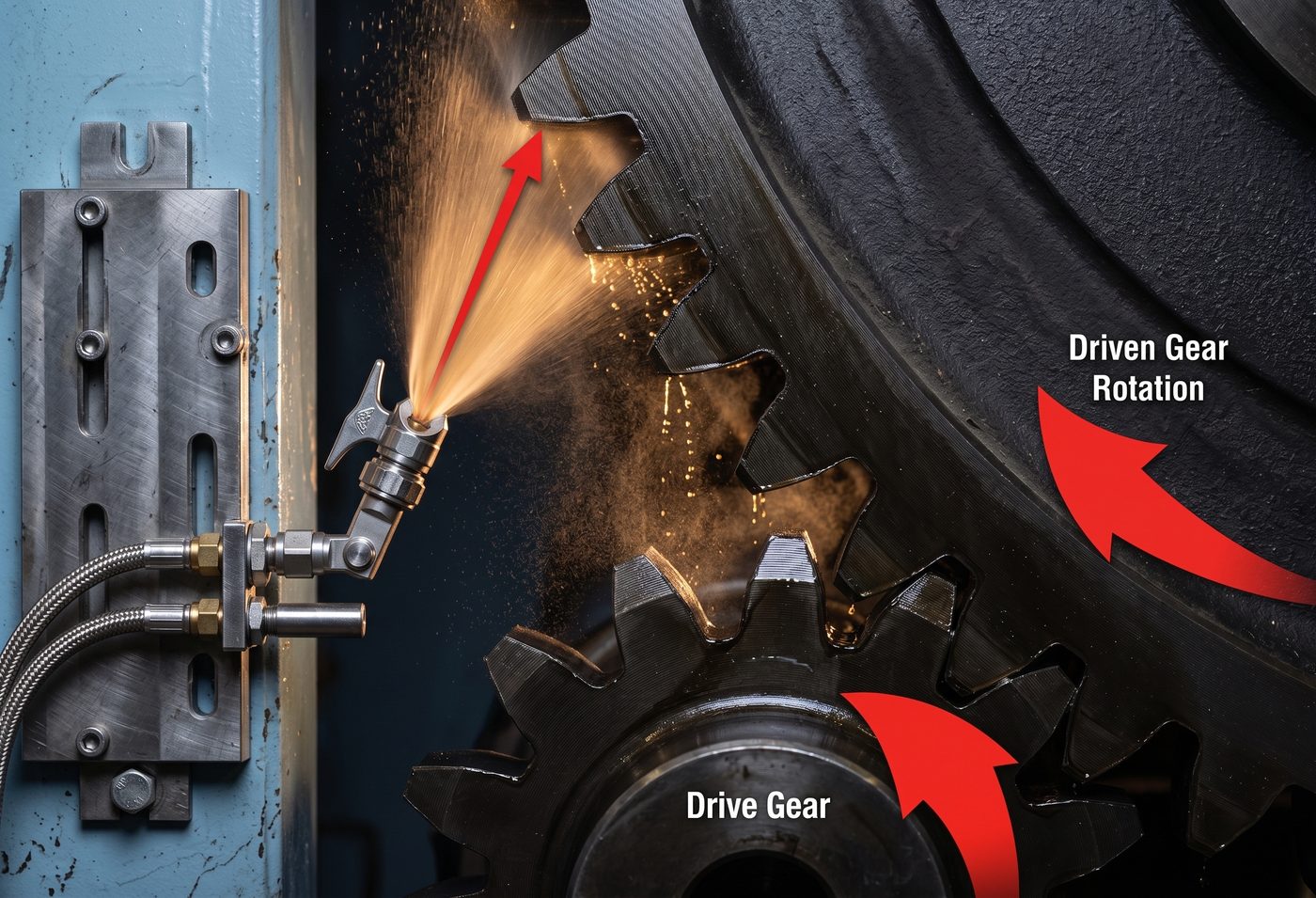
Air-atomising nozzle spraying the driven gear, before the mesh
Open gears run total loss. Lubricant goes on, does its work, and is discarded. Choosing the product is only the first of four decisions.
The other three are how the dose is measured, how the cycle is controlled, and where the spray lands. Each one can undo the product entirely.
Select the product
Open gear products fall into three classes. The machine, the duty and the climate decide which one suits.
Three product classes
Class
Thickener and form
Fluids
Clear synthetic oils, and heavy resin or polymer fluids. The class running on the mill filmed.
Soap-thickened greases
Grease built on a soap thickener.
Clay-thickened pastes
Grease or paste built on a clay thickener.
Meter it
An automatic system doses a set volume of product per shot. Three metering types are in use.
Metering types named in the recording
Type
What the recording says
Dual line
Named as one of the three types. Its working is not described.
Parallel
Named as one of the three types. Its working is not described.
Progressive
The preferred choice for ball mills, because gear OEMs want the product laid on over one or more continuous revolutions of the gear.
In a progressive system the pump feeds a supply line into a metering block. The block holds several valves, and each valve serves one spray nozzle.
The valves fire in sequence, one nozzle after the next. The block signals each time it completes a pass, and those signals are counted.
Control the cycle
Four devices run the event on the installation filmed.
01Cycle timer. Sets how often the system wakes up and starts a lubrication event.
02Pump timer. Gives the pump a set window to satisfy the counts the event requires.
03Purge timer. Runs air through the nozzles after the event, so every tip is clear for the next one.
04Counter. Counts complete cycles of the metering device. On the mill filmed it was set to five.
Once the count is satisfied the controller de-energises the pump and the event ends. It stays off until the cycle timer calls the next one.
Dose is set by counted strokes of the metering device, not by how long the pump runs.
The purge is the step most often cut short. Residual product left sitting in a tip skins over and blocks the orifice.
Place it on the gear
Four spray nozzles were mounted inside the gear cover on the mill filmed. Each throws a cone pattern, sized by its distance from the gear.
The patterns are laid out to overlap. Overlap is what gives complete coverage across the tooth flank, with no dry band between nozzles.
Either gear can be sprayed, and each choice has trade-offs. The preferred target is the bull gear, the large driven gear, rather than the pinion.
The pinion drives the gear, so the film has to arrive on the working flank of the gear tooth. On the mill filmed the gear travelled upward, which put load and drive on the back side of each tooth. The nozzles were aimed there.
The figure above shows the same arrangement. The fan lands on the driven gear, before the mesh.
How the nozzle itself does that work — external mix, the air-pressure window, bar angle and standoff — is set out in the nozzle article.
Why a semi-translucent fluid
Fluid lubricants split two ways. Clear synthetics show gear condition plainly, and drain off the covers with little cleaning.
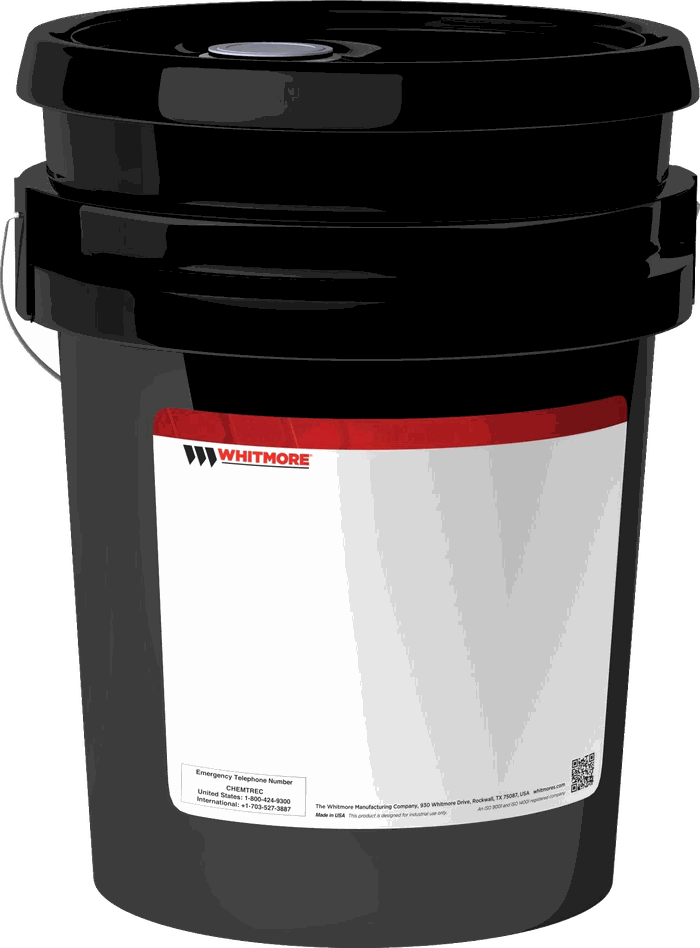
The mill filmed ran a heavy fluid, Whitmore® Envirolube XE Extreme in its Heavy grade — a resin and polymer combination, robust and tenacious.
High-viscosity fluid. Brown and transparent in service, so the tooth surface stays visible.
That visibility is the operational argument. Coverage across the tooth flanks can be read directly, without stripping the film off to inspect.
When a nozzle blocks or a metering valve fails, the gap in coverage shows. A clear lubricant hides the same gap.
It looks heavy, yet it keeps slumping off the gear and the covers. Slower than a light oil, but fast enough that little cleaning is needed.
One wording note
The recording describes the fluid as almost asphaltic-like. The record on this site has it non-asphaltic, and both hold.
The thickening is resin and polymer, not asphalt. The comparison is to how the film behaves on the tooth, not to what is in the drum.
Figures are from the Whitmore document set of 2 June 2026, pending datasheet checks. Confirm against current Whitmore TDS at quote.
03Open gear · reported result
One plant reported 40% less lubricant.
Whitmore recorded a short interview at the same plant, on the same day, in front of the same mill.
Bill Miller, the plant's Senior Reliability Engineer, says his site wanted a dependable product for its ball mills, and changed to Whitmore through its distributor.
Both passages below are quoted verbatim from that recording.
On the reduction
“by using the Whitmore grease we have cut our usage by 40% for the ball mills”
40% less lubricant used reported on ball mills, one plant
On what the site observed
“got a lot better coverage and our coverage has really increased as well for our mills. So therefore we feel like we'll get a lot longer lasting use out of our gears better wear and longer use out of material”
That is the whole of the reported result. CMD did not measure it, was not present, and does not repeat it as a claim of its own.
The quotation says grease. The product named in Whitmore's published report of the same result is a fluid. The quotation is carried unaltered, because silently correcting someone's words is worse than leaving a loose one in.
What the recording does not say
A number is only as good as the conditions attached to it. These were not attached.
Absent from the recording
Detail
In the recording
Plant name and location
Not named
Number and size of mills
Not given
Consumption before the change
Not given
Consumption after the change
Not given
Period the 40% was measured over
Not given
Product used previously
Not named
Application method and settings
Not given
Gear temperatures
Not given
Cost or dollar saving
Not given
None of it appears here either. Nothing above has been inferred, estimated or filled in from elsewhere.
Read it as one operator's experience, not as a specification. Consumption is set on site, by gear condition, application method and duty.
04Basis & further reading
Section 02 summarises a walk-through Whitmore published on 9 December 2019, presented by Bob Yerkes, a field service representative for Whitmore. Nothing in it is quoted. The only transcript available is machine-generated, and it is not reliable enough to carry quotation marks.
Every technical point in section 02 was checked against the ANSI/AGMA 9005 and ISO 18792 guidance already published on this site. Anything that did not agree, or that the transcript rendered ambiguously, was left out.
Section 03 quotes a customer testimonial, not a controlled trial. No measurement method is stated in it.
Selection, settings, rates and intervals must be confirmed against the gear OEM's instructions and Whitmore's current product data. Nothing here is a substitute for equipment-specific recommendations.